How Much Paper Do I Have? A Simple Guide to Estimating Boxes and Bins
One of the most common questions we get before a shredding job sounds something like this: "I don't really know how much I have, is that a problem?"
It's not a problem at all. But having a rough sense of your volume helps us send the right truck, give you an accurate quote, and schedule enough time on-site to get everything done in one visit. The good news is that estimating your paper volume is pretty simple once you know what to look for.
Here's a straightforward guide to help you count it up before you call.
Start With What You're Looking At: Box Types Matter
Not all boxes hold the same amount of paper. The two most common types you'll run across in an office cleanout are banker's boxes and long legal file boxes — and they work out differently when it's time to fill a shredding bin.
Banker's Boxes (Standard File Boxes)
These are the classic cardboard boxes with lids — roughly 15" long x 12" wide x 10" tall. You'll find them stacked in storage rooms, closets, and under desks everywhere. A standard banker's box holds about a ream and a half of paper when packed with standard letter-size documents and folders.
For estimating purposes, 10 standard banker's boxes fill one 96-gallon shredding bin. That's the benchmark we use, and it makes the math easy.
Long (Legal) File Boxes
Long file boxes are built for legal-size documents — they're noticeably deeper than a standard banker's box, closer to 24" in length. Because they hold more material, the ratio shifts: approximately 6 long file boxes equal one 96-gallon bin.
If you're not sure which kind you have, check the lid or measure the length. Anything over 18" is almost certainly a legal-size box.
Copy Paper Boxes
Copy paper boxes — the ones that reams of paper ship in — run a little smaller than a banker's box in terms of document volume once the paper's been mixed with folders, staples, and file tabs. Treat them roughly the same as a standard banker's box for estimating, maybe rounding up slightly if they're packed tight.
What About Bags and Loose Paper?
Not everything ends up in a box. Here's how to translate other common formats into bin equivalents:
Garbage Bags Full of Paper
A standard 33-gallon contractor bag packed with loose documents is roughly equivalent to 3 to 4 banker's boxes , depending on how tightly it's packed. Three full bags will get you close to a full bin. Five bags fills one comfortably with a little room to spare.
File Cabinet Drawers
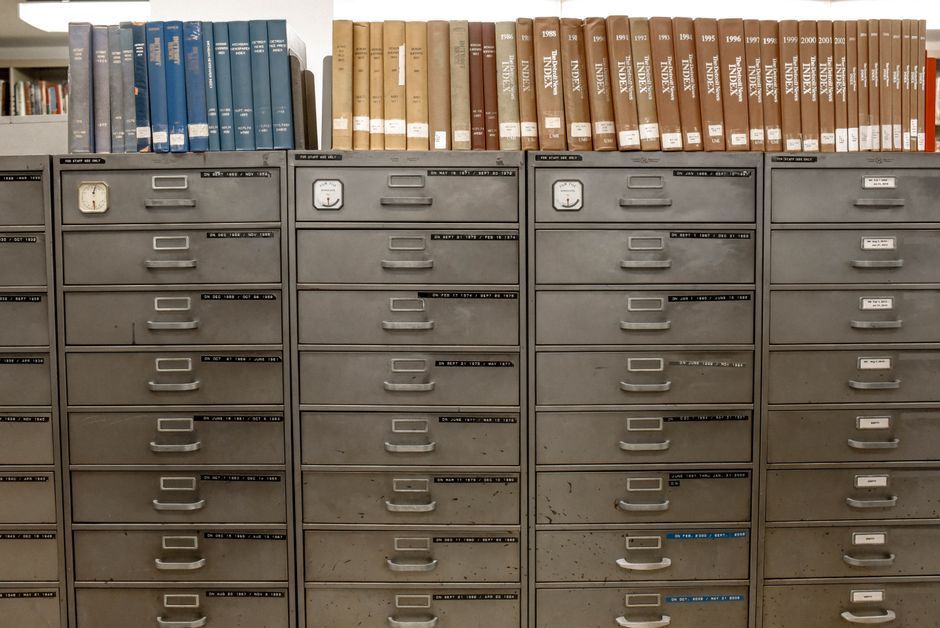
A standard lateral file drawer typically holds the equivalent of 3 to 4 banker's boxes of paper. A full four-drawer vertical filing cabinet runs about 8 to 10 boxes worth — which means one full filing cabinet is roughly one full 96-gallon bin.
If you've got multiple cabinets, count the drawers and divide by four. That gives you a quick box count without opening anything.
📦 The Quick Rule of Thumb: 10 standard banker's boxes = 1 full 96-gallon shredding bin. Long (legal-size) boxes run closer to 6 per bin. Keep those two numbers in your back pocket and the estimate almost does itself.
How to Do a Quick Walk-Through Count
You don't need to open every box or count every sheet. Here's a fast way to get a working estimate in about 10 minutes:
- Walk through every room and storage space. Don't skip the supply closet, the old server room, or that stack in the corner of the conference room.
- Count boxes separately by type. Standard banker's boxes in one group, long file boxes in another.
- Count drawers in any filing cabinets still holding paper.
- Note any bags or loose piles and estimate whether they'd fill a box or two.
- Run the math: Divide your standard box count by 10 and your long box count by 6. That gives you your approximate bin count.
If you're somewhere in between — say, 7 boxes — just round up. It's always better to have a little extra capacity than to need a second trip.
Why Volume Estimates Help Everyone
When you call to schedule a shredding pickup, even a rough volume estimate saves time on both ends. It helps us send the right truck size, give you a more accurate quote, block enough time so the job doesn't run over, and avoid a second-trip situation when volume is larger than expected.
You don't need it down to the exact box. "Around 30 boxes, mostly standard size" is plenty to work with. If you're genuinely not sure, just tell us what you can see — we'll ask a few quick questions and get you sorted from there.
🗄️ From the Field: One of the most common surprises during a purge job is the filing cabinet nobody opened in three years. If you've got cabinets in a back room or storage area, peek inside before you call — they add up fast. Four drawers per cabinet, three to four boxes per drawer. A wall of six cabinets can be 60+ boxes before anyone's touched a storage room.
One-Time Purge or Scheduled Service?
Once you have your volume estimate, the next question is usually what kind of service fits best.
If you're doing a cleanout — moving offices, closing out old files, or clearing a decade of accumulated paperwork — a one-time purge is what you need. We'll come on-site, load everything into the shredding truck, destroy it in front of you, and hand you a certificate of destruction before we leave.
If your office generates paper regularly and you want it handled on an ongoing basis, scheduled service is the better fit. We place locked consoles throughout your space, and your team drops documents in throughout the week. We service them on a set schedule — monthly, bi-weekly, or weekly depending on your volume.
As an industry leader in on-site document destruction across the Carolinas, Allways Shred™ handles jobs of every size — from a single box to a multi-room office cleanout with dozens of filing cabinets. The estimate process takes a few minutes, and we'll walk you through it if you're not sure where to start.
Count the Boxes. We'll Handle the Rest.
You don't need an exact count to get started — just a general sense of what you're working with. Ten standard boxes per bin, six long boxes per bin, and three to four filing cabinet drawers per box-equivalent. Run those numbers and you'll have a solid working estimate in under 10 minutes.
Ready to schedule? Call 833-ALLWAYS or reach out online and we'll get you a quote and a service date that works.
FAQs
What's the best way to estimate paper shredding volume for a large office cleanout?
Walk through every room and count boxes by type — standard banker's boxes (10 per 96-gallon bin) and long legal-size boxes (6 per bin) — then add filing cabinet drawers at roughly 3 to 4 boxes per drawer. A 10-minute walk-through with those numbers in mind gives you a working estimate that's accurate enough to get a solid quote and the right truck dispatched.
Does it cost more if I have more paper than I estimated?
Pricing is based on volume, so a higher count does affect the total — but it won't catch you off guard. When you call Allways Shred™, we'll confirm your estimate before the job and give you a clear quote upfront. If the actual volume runs higher on the day of service, we'll let you know before loading anything extra. No surprises.
Recent Posts