Professional Shredding Service vs. the Office Shredder: Which Is Really Cheaper (and Safer)?
Almost every office has one: the shredder in the corner by the copier. It was cheap, it seemed like the responsible thing to buy, and it handles the job. Mostly. Until it jams, overheats, or fills up at 4:45 on a Friday.
For a lot of businesses, the office shredder feels like the free option, and a professional shredding service feels like an extra expense. Once you add up what that shredder actually costs in staff time and risk, the math usually flips.
The Office Shredder Isn't Free
The purchase price is the smallest part of what an office shredder costs. Add in replacement bags, shredder oil, repairs, and replacing the machine when the motor burns out, and you've already spent more than the sticker price.
But the real cost is labor.
Someone on your staff has to feed the machine a few sheets at a time, pull staples, clear jams, wait out the cool-down period, and empty the bin. It's slow work, and it usually falls to people whose time is worth a lot more than that.
Run the numbers: If an employee earning $22 an hour spends 90 minutes a week on shredding, that's about $1,700 a year in wages for one person. Many offices have several people doing it, and that time comes straight out of work that actually grows your business.
The Security Gap Before the Shredder
Cost is the smaller problem. The bigger one is what happens before the paper ever reaches the machine.
Because shredding by hand is a chore, documents wait. They pile up in a "to shred" box under someone's desk, in a stack next to the printer, or in an open bin by the door. Some end up in the recycling bin because shredding them felt like too much trouble. That stack sitting out in the open is your real risk.
The machine itself matters too. Inexpensive strip-cut shredders turn pages into long ribbons that can be reassembled with patience. Cross-cut and micro-cut machines are better, but security levels vary widely, and most office staff have no idea which kind they're using.
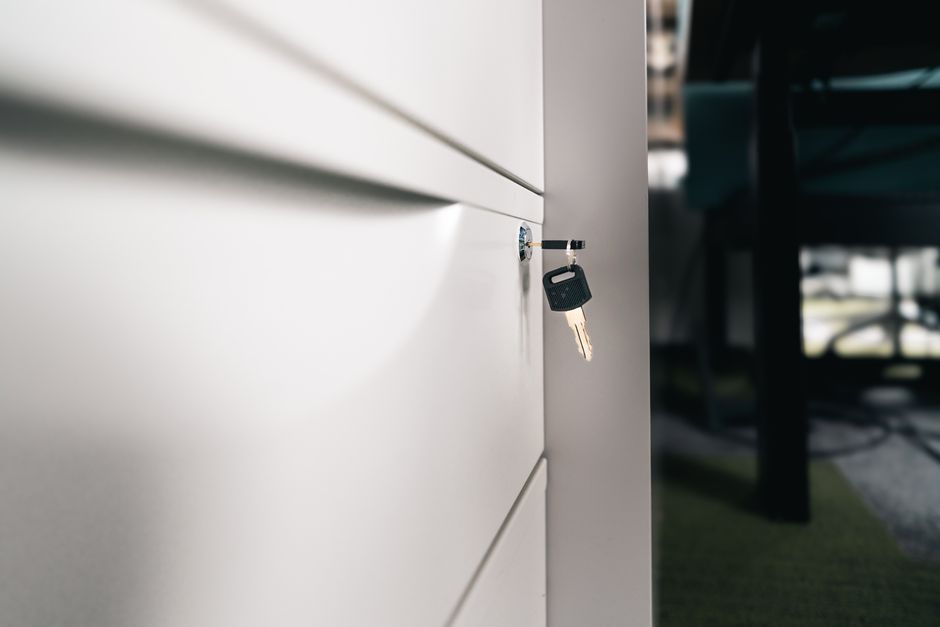
A professional service closes both gaps. Locked secure consoles mean documents go straight into a secured container the moment they're no longer needed. Nobody has to decide what's sensitive, and nothing sits out in the open waiting for someone to get around to it.
From the Field: When we set up consoles for a new client, one of the first things we often find is a box of "stuff to shred" that's been sitting in a supply closet for months. The shredder in the next room worked fine. Nobody had time to feed it.
Compliance: Can You Prove It?
If your business handles patient records, financial information, or consumer data, you're likely subject to rules such as HIPAA, FACTA, or GLBA, along with North Carolina's own requirements for disposing of personal information.
An office shredder can destroy paper, but it can't give you proof. There's no record of what was shredded, when, or by whom. A professional shredding service provides a Certificate of Destruction after every service, which gives you documentation if an auditor, client, or attorney ever asks.
Side by Side
- Upfront cost: Office shredder: purchase price plus bags, oil, repairs, and replacements. Professional service: flat service fee, no equipment to buy.
- Staff time: Office shredder: ongoing, often hours per week. Professional service: minimal; drop paper in a locked console.
- Capacity: Office shredder: a few sheets at a time; overheats with heavy use. Professional service: thousands of pounds per hour.
- Security before shredding: Office shredder: documents often sit in open piles. Professional service: locked consoles from start to finish.
- Staples and clips: Office shredder: usually must be removed. Professional service: no prep required.
- Proof of destruction: Office shredder: none. Professional service: Certificate of Destruction every service.
- Recycling: Office shredder: bags usually go in the trash. Professional service: shredded paper is recycled.
When an Office Shredder Still Makes Sense
To be fair, there's a place for a small shredder. A home office or a very small business with a handful of sensitive pages a week may be well served by a good-quality cross-cut machine. And even businesses with a professional service sometimes keep a small shredder for the occasional single sheet.
But once shredding becomes a regular task, or you handle regulated information, a professional service is almost always the better value.
How to Make the Switch
Switching takes four steps:
- Clear the backlog. A one-time purge takes care of the boxes that have been piling up in closets and storage rooms.
- Place locked consoles. We'll recommend how many and where, based on your office layout and volume.
- Set a schedule. Scheduled shredding can be weekly, bi-weekly, or monthly, depending on how much paper your office generates.
- Get your certificates. Every service comes with documentation for your compliance records.
With flat-fee pricing and no long-term contracts, Allways Shred makes it simple to try a professional service and decide whether it fits your office.
Ready to retire the office shredder? Contact Allways Shred or call (833) 255-9297 for a free quote.
FAQs
Is a cross-cut office shredder good enough for HIPAA?
HIPAA doesn't name a specific shredder type, but it does require that protected health information be destroyed so that it can't be read or reconstructed, and that your practice has appropriate safeguards around how records are disposed of. The bigger compliance challenge is usually documentation and the handling of records before they're shredded. A NAID AAA Certified service with a Certificate of Destruction addresses both. Learn more about our medical record shredding.
How much does a professional shredding service cost?
Cost depends on how much paper you generate and how often you need service. Allways Shred uses flat-fee, transparent pricing with no per-pound or per-minute charges and no long-term contracts. For many offices, the cost is less than the staff time currently spent shredding by hand. Contact us for a free quote based on your actual volume.
Recent Posts